

What is the experience gap?

For the purpose of this betabook the following definition is used:
The experience gap is the distance between what the organisation promises to deliver, and what its audiences actually experience.
The previous section defined how an organisation delivers and how impressions are formed by audiences. There are five: the employees who work for it, the customers it serves, the partners it works with, the influencers who speak about it, and the society it operates within. What an organisation promises completes the picture. It is the standard the other two are measured against, and the distance from it to the impression is the experience gap.
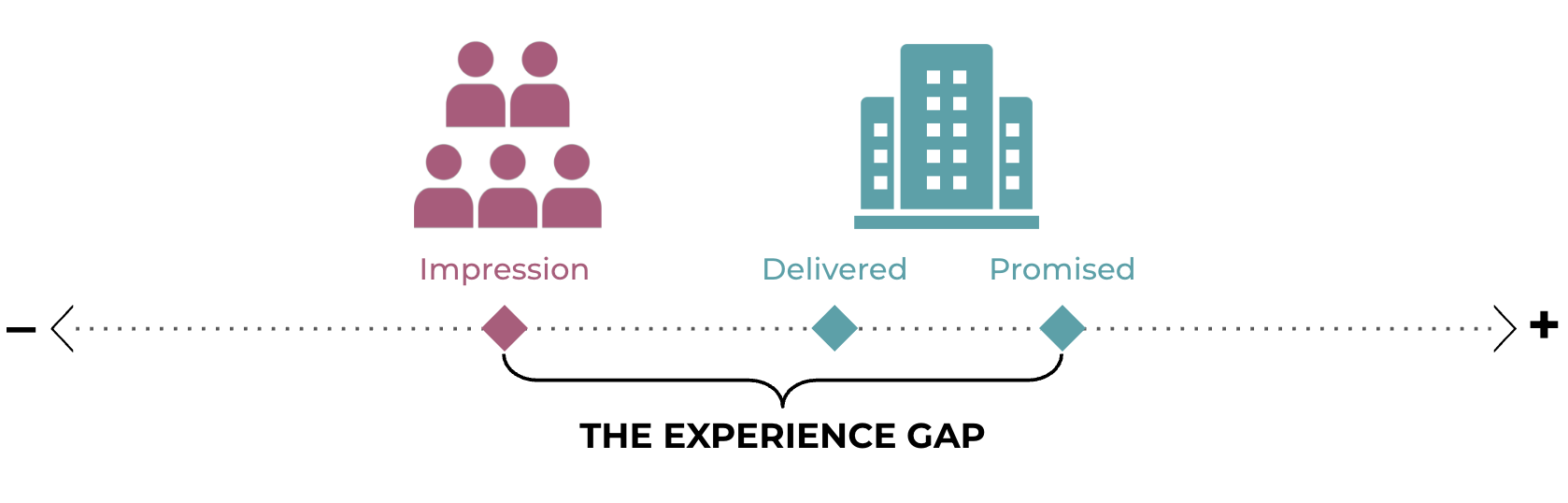
That distance has two parts, and they behave differently. The first, between what was promised and what was delivered, is a problem the organisation can govern. The second, between what was delivered and the impression it left, runs on expectation, memory and culture, which the organisation shapes without performing. The experience gap is the whole distance, because the whole distance is what an audience acts on.
The gap has always existed, but the environment in which it now exists has changed. Four converging forces are reshaping the basis on which organisations compete on experience. Together, these four forces work from both directions at once, making the gap wider, more visible, and more expensive to ignore.
Two of those forces are external pressures, acting on organisations from outside, and moving faster than most organisations are currently responding to them. Artificial intelligence (AI) is eroding the capability-based differentiation that has historically allowed organisations to compete on something other than experience. And radical transparency has made the distance between what organisations commit to and what they deliver publicly and permanently visible to every audience they impact.
1. Artificial intelligence
The basis of commercial competition is shifting. As AI reduces the cost and complexity of producing products, services, and content, functional differentiation is eroding. What once required significant capital, specialist capability, and time can now be replicated at a fraction of the cost by almost any competitor with access to the same tools. When capabilities become universally accessible, winning on features, speed, or price is no longer a sustainable edge. Organisations must compete on something else. Experience is one of the few durable differentiators that remains.
Organisations have understood for some time that customer experience is a source of competitive advantage: that the way people feel when they interact with a brand influences whether they return, whether they advocate, and whether they choose a competitor next time. What is new is the pace at which AI is making that insight commercially urgent. When two competitors can produce a comparable product at a comparable price using comparable tools, the experience of buying it, using it, and being supported through it becomes the primary variable.
AI is also creating new experience capabilities at the same pace it is commoditising old ones: personalisation at scale, predictive service, generative content tailored to individual context, real-time adaptation across every channel. In the hands of organisations with the strategic architecture to use them well, these capabilities widen the advantage of being experience-led. In the hands of organisations without that architecture, they accelerate the production of disconnected, inconsistent, and increasingly impersonal interactions. The same technology is making good experiences better and bad experiences worse, and the gap between the two is widening accordingly.
The implications extend well beyond the customer relationship. Employee experience determines whether an organisation can attract, retain, and engage the people whose judgement, creativity, and human capability will remain irreplaceable in an AI-augmented economy. The organisations that understand this are investing in the conditions that make human contribution exceptional: in the culture, the leadership behaviour, and the structural support that AI cannot substitute. Those that do not are already discovering that competitive advantage built on capability alone is dissolving faster than they anticipated, and that no technology investment compensates for the experience of working in an organisation that has not thought carefully about what its people need to do their best work.
The pressure on partner and influencer relationships is intensifying for related reasons. Partner ecosystems built on commercial efficiency alone look increasingly exposed. AI lowers the cost of finding and evaluating alternatives, standardises what can be delivered, and exposes the difference between partnerships managed transactionally and those built on mutual investment. Where a partner once stayed because looking elsewhere took time and effort, the reason to stay is increasingly the quality of the relationship itself.
Influencer relationships are under a different but related strain. As AI-generated content floods every channel, the authenticity that makes human advocacy commercially valuable is becoming harder to verify and easier to fake. Influencer relationships built on reach rather than alignment are being exposed at the same pace that the content economy is being saturated. Reach can be bought. Credibility cannot. It is extended by audiences to people they already trust, which is why how an organisation treats the people who speak for it matters more than how many followers they have.
2. Radical transparency
AI has changed what organisations can produce. Radical transparency has changed what organisations can hide. The two forces work in the same direction, both stripping away the ability of any organisation to control the narrative around what it does, what it stands for, and what its audiences encounter when they engage with it. Of the two, radical transparency is the one that has been building the longest and is now reaching the point at which most organisations can no longer manage around it.
The experience gap has always existed. What is new is that it is now permanently, publicly, and irreversibly visible to every prospective employee, every potential customer, every partner, every regulator, and every community an organisation operates within. The stakes of getting experience wrong have never been higher, and the mechanisms through which poor experience becomes public have never been more immediate or more far-reaching.
Research by the Technical Assistance Research Programs for Coca-Cola in 1981 found that customers who complained and were left dissatisfied, told an average of nine to ten people. Those who complained and were satisfied told four to five. Those figures now seem quaint given what digital channels have made possible. Various online platforms have created a permanent, publicly accessible record of experience quality that no marketing budget can override and no communications team can fully manage.
A dissatisfied customer posts a review that is visible to thousands before the organisation has had the opportunity to respond. An ex-employee’s comments influence a candidate's decision to apply before a recruiter has made contact. A single video of a poor service interaction shared on social media can reach millions within hours, and the commercial and reputational consequences can be entirely disproportionate to the operational problem that caused them.
Social media has transformed word of mouth from a private conversation into a public broadcast, amplifying both the best and the worst of what organisations deliver to audiences that extend far beyond the original interaction. AI tools have now joined it. Google's AI Mode passed one billion monthly users within a year of launch, with queries more than doubling every quarter, and BrightLocal's February 2026 survey of US consumers found that use of AI for local business recommendations rose from 6% to 45% in a single year, placing it third behind only Google and Facebook.
A growing share of people now meet an organisation first through a synthesised answer rather than a set of sources. Most then check it. BrightLocal found that 88% of people using AI for local recommendations verify the source or the legitimacy of the reviews behind the answer. Either way, the organisation's public record decides the outcome. It is what the answer is assembled from, by a system the organisation has no way to brief.
For most organisations, this is a one-way change. The conditions that made it possible to manage a controlled narrative through advertising, PR, and corporate communications are not returning. Every audience an organisation depends on now has access to information about what the organisation does, how it treats people, and how it behaves under pressure, and much of it carries more weight with them than the organisation's own marketing and communications. Nielsen found that recommendations from people you know are trusted above any other channel.
Transparency works on both parts of the gap at once. It exposes the first, by making the distance between what an organisation promises and what it actually delivers a matter of public record. And it widens the second, because the same public record is where audiences now form their expectations. An organisation that over-promises is now penalised twice: the promise raises what audiences expect, and the record shows how far short it fell.
The commercial cost of the experience gap is no longer something an organisation can absorb privately. It is paid in lost customers, lost candidates, lost partners, and lost trust, and every loss becomes part of the public record that the next audience consults before making the same decision.
~~~~~
The other two forces are internal conditions that have been building quietly inside organisations for decades. Fragmentation, the division of experience across functions, teams, and metrics, means no single part of the organisation can see, let alone close, the full experience gap. And unmanaged audiences, the partner, influencer and societal relationships that have grown commercially significant, sit outside the systems through which experience is designed and governed. The result is experience debt.
Deloitte described experience debt in 2019, as the buildup of unintended consequences that accumulates when organisations take the easier choice today without factoring in the human, and drew the same comparison to financial debt and technical debt. Its concern was what the pace of digital change is doing to people, and its remedy was to elevate the human experience. XEF uses the term for something the organisation owns. This is what builds up inside an organisation when experience goes ungoverned, and what it costs to leave it there.
Experience debt is the structural liability that builds up over time. It grows when decisions are made without their experiential consequences in mind, when investments are made in isolation rather than in concert, and when audiences are left unmanaged as their significance keeps rising.
Most organisations do not yet have a full accounting of theirs. Like financial debt and technical debt, it compounds over time, and the longer it remains unaddressed, the more costly and disruptive it becomes to resolve.
3. Internal fragmentation
The central problem with how experience is currently understood and managed in most organisations, is that each function is solving for a fragment of something that only has value when it is understood as a whole. For decades organisations have been investing seriously in experience: building CX teams, launching EX programmes, adopting design thinking, and articulating brand frameworks intended to create consistency across every audience relationship. And yet the gap still persists.
The consequences are visible in how organisations are structured and how they operate. When the CMO and the CPO mean different things by experience, they build different teams, invest in different tools, measure different outcomes, and arrive at different conclusions about whether the work is succeeding. When the CDO treats experience as a digital optimisation challenge and the COO treats it as a process efficiency challenge, the organisation ends up with a beautifully designed app sitting on top of a frustrating operational reality. When each function defines experience through its own lens and optimises for its own definition of success, the result is a collection of well-intentioned efforts that collectively fail to close the experience gap.
This is fragmentation, and unlike the external pressures of AI and radical transparency, it is an internal condition that makes organisations vulnerable to those forces. Fragmentation creates organisations that can score highly on customer satisfaction while simultaneously haemorrhaging talent. That can deliver a seamless digital product while treating supply chain partners with indifference. That can articulate a compelling purpose on a website while employees would never recognise it in their daily working lives. When experience is fragmented, it becomes a collection of good intentions, separated by organisational boundaries.
4. Unmanaged audiences
Customer experience and employee experience have dominated the experience management conversation for good reason, as both are directly and consistently linked to revenue, retention, advocacy, growth, and the day-to-day quality of organisational life. Three other relationships have become significant over the same period, and most organisations have not built the architecture to manage them. Partners, influencers and society shape organisational performance today in ways they did not a decade ago, and they do it largely outside the systems through which experience is designed, governed, and measured.
Partners: The external parties in an ongoing, designed relationship with the organisation that create or enable the value it delivers. They fall into two groups: operational partners, such as distributors, suppliers, and co-innovation partners, who deliver outcomes on the organisation's behalf; and capital partners, the investors and funders whose commitment of capital enables the organisation to operate and whose confidence it must actively earn and retain.
Operational partners, the suppliers, distributors, franchisees, and commercial collaborators whose performance is essential to everything an organisation delivers, have moved from being managed as vendors to being recognised as co-creators of the customer experience. How an organisation manages those relationships now matters on two levels simultaneously. The quality of the relationship directly determines the quality of the experience it can deliver to its customers. And radical transparency has ensured that the conditions under which it does so are permanently visible, from the terms of its supply chain to the standards it applies to the treatment of its partners, to every audience whose trust the organisation depends on.
The organisation actively designs how it engages capital partners, through investor relations, reporting, and the way it answers the environmental, social, and governance questions that increasingly shape investment decisions. Their confidence is earned through what the organisation does, not what it reports, and it shows up directly in the cost and availability of the capital the organisation depends on. For a commercial business these are its investors; for a not-for-profit, its donors and grant-makers; for a public body, the bodies that fund and authorise it.
The organisations that understand this invest in their partner relationships with the same intentionality they bring to their customer relationships. Salesforce, the world's leading cloud-based CRM platform, built its growth model on this principle. The company recognised that its success depended not on what it could deliver directly, but on what it could enable its partner ecosystem to deliver on its behalf. The scale of what now flows through that ecosystem is considerable. IDC's 2023 Salesforce Economy study, sponsored by Salesforce, forecasts that the company and its partner ecosystem will generate more than $2 trillion in net new business revenue and 11.6 million jobs between 2022 and 2028.
The same study asked users of AI-powered cloud solutions which services were crucial to their implementation, on top of a basic cloud subscription. They named project consulting or systems integration, additional cloud services, IT training, IT managed services, and business consulting. Salesforce reads this as evidence of the growing role of partner apps and experts in a working AI deployment. The subscription was the starting point rather than the result.
The Working Relations Index has measured how Tier-1 suppliers rate the six major North American automakers every year since 2001, and Plante Moran reports that twenty-six years of data show a correlation between those scores and commercial performance. What the index measures tracks what suppliers choose to give: competitive pricing, investment in innovation and technology, and better support at programme launch.
What that evidence shows is not the size of the ecosystem but its necessity. The product on its own did not produce the outcome. Where partners carry that much of what the customer finally receives, how they are treated stops being a procurement question.
Influencers: The individuals, communities, and institutions whose advocacy shapes how organisations are perceived have become one of the most commercially consequential and least systematically managed audience relationships available. These are the people who amplify or undermine everything an organisation does, often with more credibility and reach than any paid campaign. As AI-generated content proliferates, authentic human advocacy is becoming more scarce and more valuable. Yet most organisations manage these relationships through public relations and communications functions optimised for message control rather than engagement. When the experience of this audience is neglected, the consequences can be swift and public.
The Fyre Festival is the starkest illustration. In late 2016, its organisers used some of the world's most-followed influencers, among them Kendall Jenner, Bella Hadid, and Hailey Bieber, to post a coordinated series of orange tiles that, by the campaign's own account, reached hundreds of millions of people within a day. Some tickets were priced at $12,000, for a luxury island festival that was never built. When attendees arrived, they found half-built tents and cheese sandwiches in place of villas and gourmet meals. The founder, Billy McFarland, was later sentenced to six years in prison for fraud and false statements, with over $26 million lost across 2 schemes. The influencers were not charged, but they carried the reputational cost of having lent their names to it. The deeper lesson is about how organisations treat influencers: as a distribution channel for reach, rather than as an audience with their own standards and their own reputational stake in the partnership. The question no one appears to have asked was whether the experience being sold matched the reality being built.
A 2023 YouGov study across 18 markets asked people what happens to their view of a brand when an influencer connected to it is in the news for the wrong reasons. Twenty-eight percent said they would trust the brand less and buy less from it. Another 17% said their trust would be damaged even if they kept buying. Only 22% said their view of the brand would be unaffected, and the effect was strongest among under-35s.
Fyre showed what this looks like when it happens. The damage does not stay with the influencer. It reaches the organisation that hired them, from an event the organisation had no part in and no control over. The practical response is to treat influencers as a primary audience, whose experience of your organisation, your values and your product needs to be genuine, transparent and reciprocal.
Society: The communities, environments, regulatory bodies, and civil institutions within which organisations operate have moved from the periphery of the experience management conversation to its centre. This is partly the product of radical transparency, which has made the relationship between an organisation's stated values and its societal impact permanently visible. But it is also the result of a shift in audience expectations. This is not corporate social responsibility rebranded; it is the recognition that organisations do not exist in isolation. They draw on shared resources, shape public discourse, influence political and economic systems, and leave lasting marks, both positive and negative, on the societies they inhabit.
Organisations that ignore this audience do so at increasing peril. Some of the most instructive examples come from industries where the gap between corporate positioning and societal impact has been exposed not by a single event but by the accumulating weight of evidence over time.
- Nestlé spent decades facing sustained global criticism over its marketing of infant formula in developing countries, promoting a product in markets where clean water was scarce and where the cost of formula represented a significant proportion of household income. An NBER working paper later estimated that this marketing was associated with measurable increases in infant mortality among households without clean water access. Sixteen years after the controversy reached its peak, Nestlé committed to becoming the world's leading nutrition, health and wellness company. The experience of the communities most affected had already told a different story, and the reputational damage, sustained across generations of consumers and activists, has proved far more durable than any strategy designed to move beyond it.
- Fast fashion provides an equally instructive example at industry scale. When the Rana Plaza garment factory in Bangladesh collapsed in 2013, killing more than 1,100 garment workers, it did not merely expose the safety failures of a single building. It did not merely expose the safety failures of a single building. It exposed a purchasing system in which brands did not know whose hands their garments passed through, and could not easily be made to find out. The brands sourcing from the building, some identified by labels recovered from the rubble, discovered that the societal experience of their supply chain was inseparable from their consumer brand, regardless of how carefully they had managed the distance between what consumers saw and what their suppliers did.
In each case, the lesson is the same: society is an audience with a long memory, an increasingly powerful voice, and a growing intolerance for the gap between what organisations say they stand for and what their actions reveal about their actual priorities. What has changed is the speed of exposure, not the speed of the consequence. A failure becomes visible in hours. The cost of it arrives over years, and it does not expire.
~~~~~
The experience gap does not stay the same size when left unaddressed. Organisations that are not actively closing the gap are not standing still; they are falling behind in an environment that is accelerating around them. Each of the four forces is widening it faster than most organisations are currently equipped to respond.
- AI is commoditising
- Transparency is exposing
- Fragmentation is constricting
- Audiences are multiplying
The urgency of closing the experience gap is a straightforward argument. The organisations that do not close it now, will find the cost of closing it later far greater than the cost of building the architecture to address it today. Organisations that choose to build experience into their architecture do not simply generate better outcomes. They build something that cannot be purchased or easily replicated, because it is not a capability. Closing the gap is not the end of the ambition. It is the beginning of the advantage.


