

Strategy

The Strategy dimension produces experience principles, the most foundational component in XEF and the one every other element depends on. They are the standard against which audience experiences are defined, the filter through which operational decisions are evaluated, and the benchmark against which performance is measured.
Get them right, and the entire framework has traction. Get them wrong, or skip them entirely, and the consequences can travel through every subsequent dimension. Audience experiences are defined without a governing standard, operating models are built without a shared direction, and measurement frameworks have nothing precise to evaluate against. The investment continues, the improvement does not.
The preceding chapters set out what the integrated frameworks established, and what none of them supplied. Every one of them derives its standard from outside the organisation, from what audiences expect and what competitors are doing, which leaves the organisation working towards a target set elsewhere and gives its separate audience definitions no common source. Experience principles are the answer to both. They give the organisation one standard, derived from what it believes and has promised, that every audience definition is built from and every function can act on.
Experience principles is not a term with a single agreed definition. It is used across the brand, customer experience, and UX communities, and each uses it differently. Each usage has merit within its domain. None of them is sufficient as the foundation for a whole-organisation experience strategy.
- In brand strategy, they are sometimes used interchangeably with brand values or brand behaviours.
- In customer experience, they occasionally appear as a framework for defining the intended quality of the customer journey.
- In UX, principles are design guidelines that help teams make consistent decisions about how a product should feel and behave.
For the purposes of XEF the definition is broader, more operational, and more commercially grounded than any existing usage:
Experience principles are behavioural standards, derived from organisational values and promise, that govern how an organisation behaves towards every audience, in every interaction, across every function.
Experience principles serve four interconnected purposes within XEF:
- They ensure alignment, giving every part of the organisation a shared understanding of what the intended experience looks like, reducing the inconsistency and internal friction that fragmentation produces.
- They improve decision-making, providing a clear filter for competing priorities, design choices, and resource allocation.
- They create consistency at scale, ensuring the experience across every channel, touchpoint, and interaction is coherent.
- They connect individual contribution to organisational purpose, helping people understand how their specific role shapes the experience the organisation has committed to delivering, which supports engagement and accountability.
This chapter explores what experience principles are, how to develop them, and what makes them effective, moving beyond language that nobody acts on toward genuine organisational ownership.
How principles work
Experience principles are behavioural standards that should be expressed in language clear enough for anyone in the organisation to understand and specific enough to govern real decisions.
A principle that says "We make complexity feel simple" is not just a design brief. It is a standard that a product engineer, a finance director, a customer service agent, and a procurement manager can all apply to their own decisions without needing a brand team to interpret it for them. It tells the engineer to remove unnecessary steps from the onboarding flow, the finance director to simplify the invoice, the customer service agent to give a straight answer, and the procurement manager to reduce the burden of supplier onboarding. None of those four decisions is a touchpoint anyone designed as an experience. They are ordinary decisions, made by people who would not describe their work as experience work, and they are the part principles exist to reach. This is what separates an experience principle from a values statement. A values statement describes what the organisation believes. A principle tells people how to act on it.
Defining the inputs
Experience principles are derived from two inputs: values and a promise. Values are what an organisation believes, the core convictions that define what it stands for. The promise is what it commits to deliver to its audiences, its beliefs turned into an obligation to the people it impacts. Experience principles are the behavioural standards derived from both: the bridge that turns what an organisation believes and has promised into how its people act. Values are internal and enduring, the promise points them outward to an audience, and principles make them operational.
Each of these inputs can sit at one of two levels, the organisation or the brand.
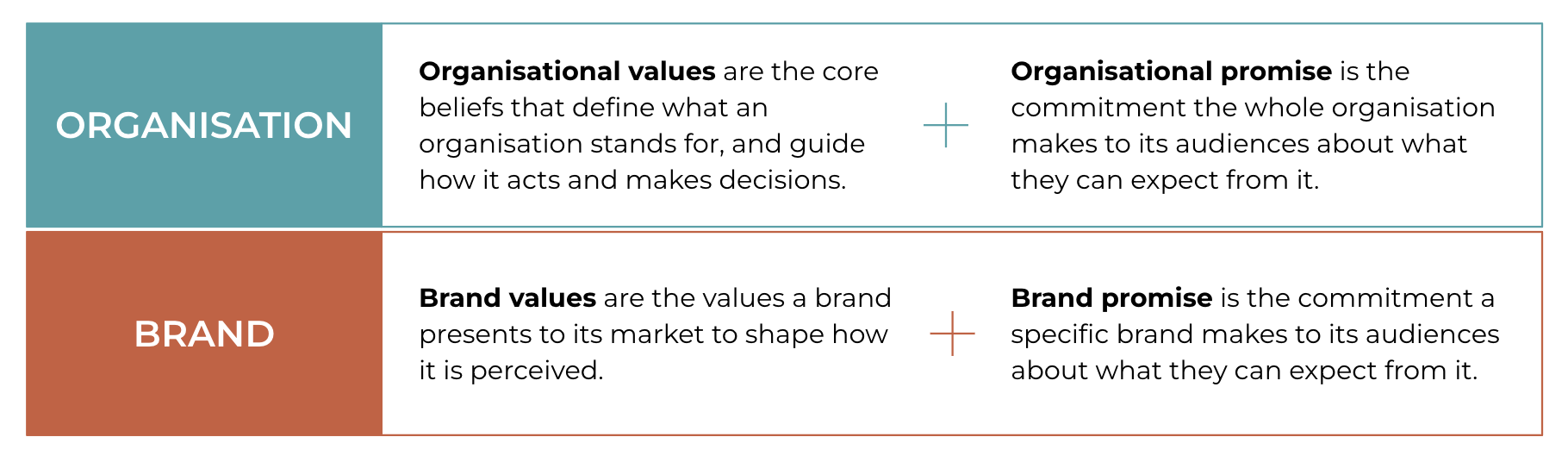
Which level you use, either organisation level or brand level, is determined by where the organisation sits on the continuum between a single master brand and a portfolio of separate brands.
A branded house
At one end of the continuum is what Aaker and Joachimsthaler’s brand relationship spectrum describes as the branded house, where the organisation is the brand. FedEx is one example. In a branded house, the two levels are the same thing, so there is one set of inputs and one set of principles, governing every audience.

A house of brands
At the other end is the house of brands, an organisation that operates several distinct brands. Procter & Gamble, which owns Oral-B, Pantene and Pampers among others, is an example. In a house of brands the inputs split by audience.
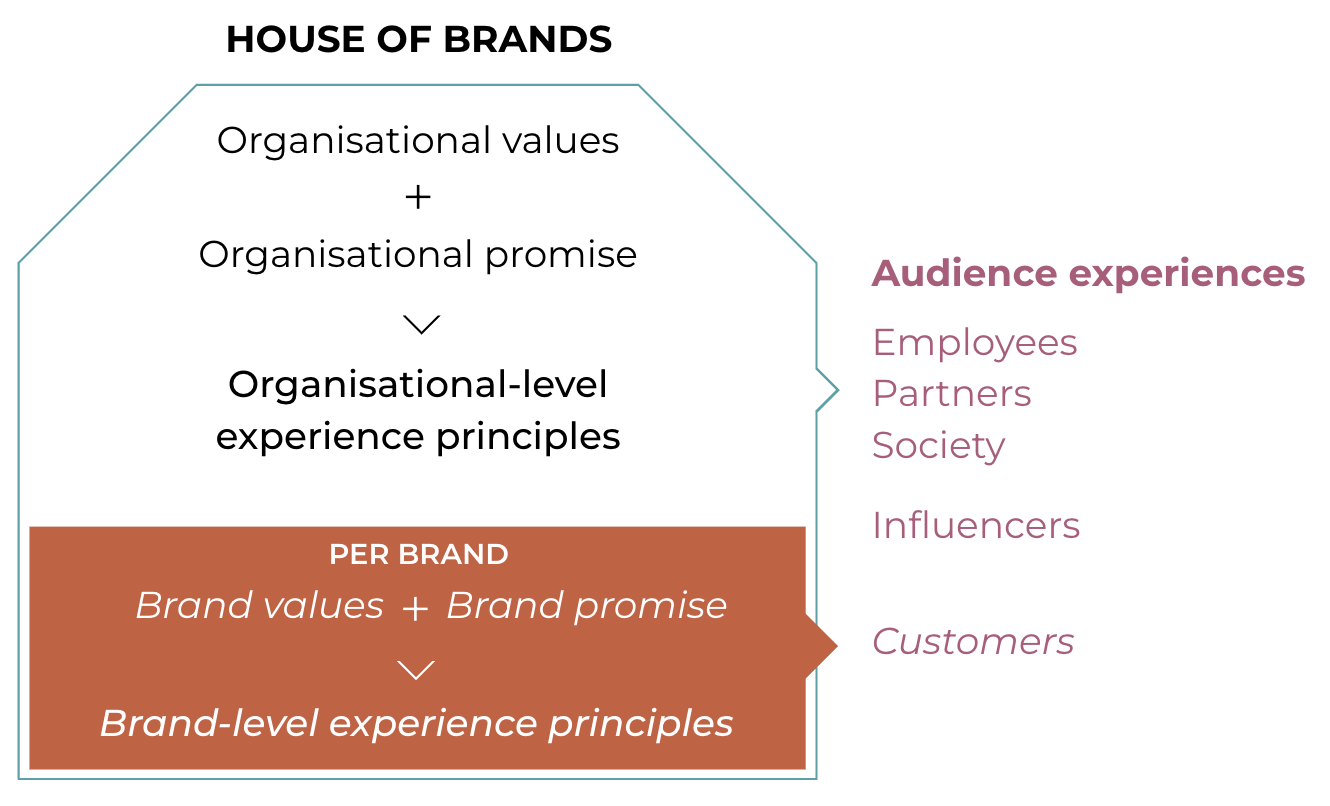
Employees, partners and society generally relate to the organisation rather than to any single brand. Procter & Gamble’s employees work for the group rather than for Oral-B or Pampers, society grants its licence to the organisation, and most partners contract at that level. These audiences are governed at the organisational level, and their principles are shared across every brand.
Influencers can either relate to the individual brand (a content creator) or the organisation as a whole (a journalist).
Customers relate to the individual brand, often without knowing the parent organisation exists. They are governed at the brand level, and their experience principles are created for each brand from that brand's own values and promise.
The organisational values still apply here, as a boundary. A brand derives its experience principles from its own values and promise, but it cannot adopt a principle that breaches what the organisation as a whole stands for. The organisational values set the limit that every brand stays within, which is what makes this one organisation running several brands rather than a collection of unrelated ones.
Everything in between
Many organisations sit somewhere between these two ends. Within XEF where they sit, and therefore which inputs they use for which audiences, rests on two separate factors.
- The first is how structurally integrated the organisation is. Marriott International runs more than thirty hotel brands, from Ritz-Carlton to Moxy, through a single company rather than a separate business for each brand. There is no Moxy company to be employed by or to contract with, so anyone employed by Marriott or contracting with it is dealing with the group, and those audiences are governed at the organisational level. Marriott is also a franchisor, and most of the properties carrying its brands are franchised. The people working in them are employed by the franchisee, which makes them the franchisee’s own employee audience and makes the franchisee one of Marriott’s partners. Where an audience deals with a separate company in this way, it relates to that company, and its principles are set there rather than by the group.
- The second is how visible the parent is to the market. Marriott is highly visible. Marriott Bonvoy connects every brand in the portfolio back to the parent, and customers move between brands within a single relationship. Where a parent is visible in this way, its values and promise form part of what customers and influencers encounter, so the principles for those audiences draw on the organisational inputs as well as the brand’s own. Inditex sits at the other end. It runs Zara, Pull&Bear, Massimo Dutti, Bershka, Stradivarius, Oysho and Zara Home, and someone shopping in Zara is unlikely to be thinking about Inditex at all, so those principles come from the brand alone.
These two factors move independently. Working out the right inputs is therefore a matter of answering both questions for each audience: does this audience relate to the group, the operating company, or the brand, and how much of what they experience comes from the parent. The answers tell you whether to reach for the organisational inputs, the brand inputs, or a combination of the two.
Combining the inputs
The previous section defined the two inputs, a set of values and a promise, and explained which level each is drawn from. Of the two, the values are the foundation, because they are what the principles ultimately express. But values are not turned into principles on their own. The promise, the commitment the organisation or brand makes to its audiences, does specific work the values cannot do by themselves.
Values, on their own, do not settle much. They are convictions, held inwardly and stated in general terms, and they tend to be broad and widely shared. Integrity, excellence, respect and customer focus appear as values for many organisations. A single value can justify many different behaviours, and most values do not point at anyone in particular. The promise resolves both.
The promise directs. A value describes what an organisation holds true, but not what it has committed to deliver, or to whom. Because a value can justify many behaviours, something has to decide which of them matter most, and the value cannot do this itself.
The promise can. It points the value outward, turns it into an obligation toward an audience, and narrows the range of things the value could mean down to the behaviours that deliver what has been promised. Two organisations can hold an identical value and make opposite promises: both may value integrity, yet one promises radical transparency while the other promises discretion and confidentiality. The value permits both. The promise chooses. This is also where distinctiveness enters, because it is the promise, not the value, that separates two organisations with near-identical values and makes their principles visibly different.
The promise commits. A value does not say what would count as failing it. A promise does, which is what makes the principles derived from it answerable. It is also what links them to measurement, because the experience gap is the distance between what has been committed to and what audiences encounter. Whether the principles are organisation-level or brand-level, derived from the organisation's values and promise or a brand's own, the promise does the same work in the same way.
For example, suppose a bank values fairness. That value alone could justify almost anything, from identical treatment for every customer to individually negotiated terms, and each could be defended as fair. Now add the promise that no customer will be penalised for staying loyal. The direction becomes clear: close the gap between new-customer and existing-customer pricing, and remove the loyalty penalties buried in renewals. The value left the choice open. The promise made the choice, and the principles turn that choice into how the organisation behaves.
For the promise to do this work, it has to be a genuine and specific commitment. A promise that simply restates the values in more appealing language adds nothing, because it cannot direct or hold to account anything the values did not already. This is why a promise must be clear, credible, and genuinely held before it can sit above the principles.
Principles are therefore derived from both values and promise, rather than from either alone. Values are enduring, while a promise can evolve as an organisation or brand grows or repositions. The values keep the principles grounded when the promise changes, and they govern conduct in the many ordinary moments the promise does not explicitly address. The promise gives the principles their direction, their distinctiveness, and their audience. So a principle that draws on both reflects all three: what is believed, what has been committed to, and how it is acted on.
What makes a principle effective
The difference between a principle that governs decisions and one that is used for decoration comes down to four qualities. Language that sounds compelling in a workshop and changes nothing in practice is the common failure, and these four are what catch it.
Strategically connected. An effective principle supports the organisation's broader strategy. It does this through the chain it is built from: the values and the promise are shaped to serve the strategy, and the principles are derived from the values and promise. So a principle that is properly derived carries that strategic connection down into everyday behaviour. This is what gives a principle its authority and its durability. It also sets a real test. A principle can be faithfully derived from the values and promise and still be strategically disconnected, if those values and promise were generic or written with no real link to where the organisation is heading. So the question is not only whether a principle traces back to the values and promise, but whether that chain serves the strategy.
Distinctive. As the previous section explained, distinctiveness enters through the promise, and the promise is distinctive because it reflects the organisation's or brand's particular strategy and position. So the test is not whether a principle is merely worded in a memorable or unusual way, but whether it is distinctive in a way that reflects where the organisation or brand is trying to go. A principle can be vividly phrased and still be generic in substance, or specific to nothing real. The check is whether it could belong to any organisation or brand, or whether it reflects the strategy and position that it was developed for.
Behavioural. An effective principle describes how people should act, not how the organisation or brand wants to be perceived. The test is whether the principle names a behaviour. "We are innovative" describes a quality the organisation wants to claim. "We bring people with us when we move fast" describes something a person can do. A principle that names an aspiration rather than an action has not yet met this quality, however well it reads.
Testable. An effective principle works as a decision filter. When a real decision is placed against it, it should be possible to tell whether the decision is consistent with the principle or not. And it has to work across the full range of decisions and audiences the principle is meant to govern, including the ordinary ones nobody thinks of as experience decisions. A principle that guides the design of a customer journey but offers nothing to someone drafting a payment term is not yet doing the work. A principle that resolves one situation cleanly but offers no guidance across the breadth of situations it should cover, or that cannot help choose between two courses of action, is not specific enough to be useful.
How to develop experience principles
There is no universal answer to how many principles are needed. Within XEF the working range is three to seven. Fewer than three and the language has to stretch so far that it stops being directive; more than seven and nobody carries the whole set into a decision. The goal is clarity. A set of four principles that every leader can articulate, apply, and be held accountable against is worth far more than a set of ten that, while comprehensive, live in an onboarding document and nowhere else.
Developing principles that meet this standard requires a deliberate process. It should:
- Ground the principles in the organisation's strategic foundations
- Draw on audience insight
- Involve the people who will be expected to live by them
- Connect the resulting principles explicitly to the strategic outcomes they are intended to support
Principles handed down from leadership or produced by a small team in isolation tend to generate compliance rather than commitment. Principles developed with the people expected to live by them generate ownership, which is what makes them operational.
Developing principles at the organisation and brand levels
The development process is the same whichever level you are working at. What changes in a multi-brand organisation is how many times you run it, and who is involved each time.
A branded house runs it once, producing one set of principles for every audience, developed with the organisation as a whole. A house of brands runs it once at the organisation level, for the audiences governed there, and again for each brand, involving the people who run and deliver that brand. An organisation with four distinct brands therefore develops one organisation-level set and four brand-level sets, following the same split between audiences established earlier.
Two things keep this from fragmenting. The practical range still applies at each level: a brand working within a shared organisation-level set does not need seven principles of its own as well, or the total a person has to remember becomes unworkable. The brand-level set should stay small, covering what is distinct about that brand's customer and influencer experience and no more. It operates within the limits the organisation-level principles set, so the brands remain recognisably part of one organisation rather than drifting into separate standards.
Insight and involvement shift with the level too. Organisation-level principles draw on the audiences and people that span the whole organisation. Brand-level principles draw on that brand's customers and the teams closest to them. Running the process at the wrong level, developing customer principles centrally without the brand teams, or letting a brand set principles for audiences it does not own, undermines the whole split.
Common failure modes
Even organisations that invest seriously in developing experience principles frequently encounter the same failure modes. Recognising them in advance is the most effective way to avoid them.
The most common is language over substance. Principles can be beautifully written and sound compelling, but are often too abstract to govern decisions. This typically happens when the development process prioritises creative expression over strategic rigour, or when the principles are reviewed mainly by brand and communications teams rather than by the operational leaders expected to apply them. It is the failure the four quality tests exist to catch, a principle that reads well but is not behavioural, not testable, and not distinctively connected to the strategy.
The second is leadership detachment. Principles developed without senior involvement lack the authority and visibility to become organisational standards. Principles that leaders do not personally champion, model, and hold others accountable against do not become principles.
The third is absence of accountability. Principles developed without a corresponding measurement framework provide no way to assess whether the organisation is living them. When there is no consequence for the gap between intention and behaviour, the principles gradually recede from operational life regardless of how well they were developed.
The fourth is one-time development. Principles are not a fixed output, they are a living standard which should evolve as the organisation, its audiences, and its competitive environment change. An organisation that set its principles five years ago and has not revisited them may well be operating against a standard that no longer reflects its strategic reality.
The fifth is confusing the levels. This only applies to multi-brand organisations, and takes two forms. Applying one organisation-wide set to every audience erases the differentiation that brand-level principles exist to create. Letting each brand set its own principles for every audience fragments the organisation-level audiences that should be governed once and shared. Both come from the same mistake: losing track of which audiences sit at which level, as set out earlier. Done at the wrong level, the split stops doing the work it exists to do.
The ultimate test
The ultimate test of an experience principle is whether it changes how decisions are made in practice. Anyone making a decision on the organisation's behalf, regardless of their role or function, should be able to apply it to a real decision they are facing and reach a choice more consistent with what the organisation intends than they would have reached without it. This is the standard XEF holds principles to. Not eloquence. Not inspiration. Governance.
When principles meet this standard, experience stops being the responsibility of whoever happens to be paying attention in any given moment. It becomes the shared responsibility of everyone: governed by a common standard, measurable against a defined intent, and owned by every person with a decision to make.
Chapter summary
Experience principles are the standard everything else is built on. They are behavioural standards, derived from organisational values and promise, that govern how an organisation behaves towards every audience, in every interaction, across every function. A values statement describes what the organisation believes. A principle tells people how to act on it. Without them, audience experiences are defined without a governing standard, operating models are built without direction, and measurement has nothing precise to evaluate against.
Principles are derived from two inputs: values and promise. Values are what an organisation believes, and the promise is what it commits to deliver. Drawing on both keeps principles grounded when the promise changes, and gives them direction, distinctiveness, and an audience. Experience principles are developed both at the organisational level and brand level, depending on how the organisation functions.
Four qualities separate a principle that governs from one that decorates.
Strategically connected: tracing back through the values and promise to where the organisation is heading.
Distinctive: in substance rather than phrasing.
Behavioural: naming something a person can do rather than a quality the organisation wants to claim
Testable: working as a filter on real decisions, including the ordinary ones nobody thinks of as experience decisions.
Development matters as much as wording. Three to seven principles is the practical range: fewer is too broad to direct anything, more is too complex to remember. The process should ground them in the organisation's strategic foundations, draw on audience insight, and involve the people expected to live by them. Principles handed down from leadership tend to produce compliance rather than commitment. Principles developed with people generate ownership, which is what makes them operational.
The ultimate test is whether they change how decisions are made.


