

Audiences

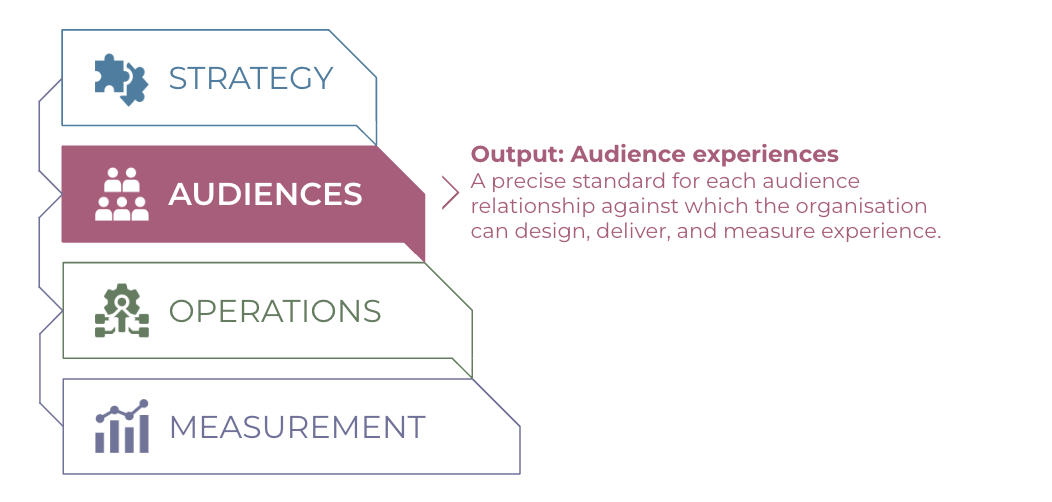
The Audiences dimension of XEF translates the experience principles into something more specific and more operational: a defined, intended experience for each audience across their full relationship with the organisation.
Articulating values is common. Developing principles is less so. Turning either into an operating standard is rarer still, and it is where this dimension does its work. It requires a detailed definition of what the intended experience looks and feels like for each audience, at each stage of their relationship. It covers the touchpoints and interactions the organisation has designed, and the ordinary decisions it has not: the ones made in the course of normal work by people who would not describe themselves as working on experience. Without this definition, principles remain abstract. With it, they become actionable: a precise standard against which the organisation can design, deliver, and measure experience across every audience relationship it has.
Experience principles establish the behavioural standard the organisation has set. But a principle alone, however well written, cannot tell every employee in every function exactly what that principle looks like in the specific context of their work. That translation is what audience experience definition provides.
Take a principle like "We keep our word." At the level of the principle, this is clear and meaningful, and every leader in the organisation can understand what it is asking of them. But understanding a principle and knowing how to apply it are two different things.
- A customer-facing team needs to know what it means when a delivery date is going to slip. Does the customer hear about it from the organisation before the date passes, or find out when the parcel fails to arrive? What specifically should the organisation do, and when?
- An HR team needs to know what it means for a candidate who was told they would hear back within a week. What happens when a hiring decision is delayed, and who is responsible for making sure the candidate is not left waiting in silence?
- A partner manager needs to know what it means when the organisation cannot meet a commitment in a supply agreement. How early is the partner told, what is offered to put it right, and does the organisation absorb the disruption or pass it on?
The principle is the same in each case, but the experience it needs to produce is different, because the audience, context, and moment are all different.
Audience experience definition is the work of making those translations explicit. For each of the audiences, at each stage of their relationship with the organisation, in each of the moments that shape the overall impression they form, it answers the question that a principle alone cannot. What does this principle look and feel like here, for this person, in this moment? It is the connective tissue between what the organisation has promised at the strategic level and what it delivers at the operational one. It is where the real complexity, and the real value, of experience strategy lives.
The audience value proposition
At the core of each audience's intended experience is its value proposition: the promise of what that audience receives in return for its engagement with the organisation. Where the experience principles set how the organisation behaves toward an audience, the value proposition states what that audience gains by engaging. The value proposition is constant through every stage of the relationship, and what changes from stage to stage is how the organisation delivers on it, not the proposition itself.
For some audiences this is already established practice. The employee value proposition (EVP), defined as what an organisation offers in return for the skills, capabilities and experience an employee brings, is a standard part of employer branding. The customer value proposition (CVP), the older concept from which the others derive, sets out why a customer would choose one offering over another. This is where XEF differs from common practice. The named propositions are established, but each is usually built by the function that owns that audience, from what that audience wants and what competitors offer, so they have no common source. In XEF every one of them derives from the same promise and values.
For the remaining audiences, the same logic holds even where the named practice is less settled. The term partner value proposition (PVP) is used in channel practice, but it has no settled definition of the kind the customer and employee versions have. Influencer relationships are usually described in terms of what the influencer offers the organisation, so there is no standard influencer value proposition to refer to. XEF treats the relationship in both directions and asks the reciprocal question: what the organisation offers in return that would lead an influential voice to engage with it authentically and repeatedly.
Society works differently. The other four audiences engage with the organisation by choice, and their value proposition is what they receive in return for that engagement. Society does not choose the relationship and cannot leave it, so its value proposition is not a return for engagement but an obligation: what communities, the public, and the environment are owed by an organisation operating in their midst. The related idea of a social value proposition already exists, has been used to describe the social value an organisation creates for its beneficiaries. Here it takes its place as what society receives from how the organisation operates, and the basis on which it grants, and can withdraw, the organisation's licence to operate.
Defining the value proposition for each audience is what keeps the intended experience honest. It names the return each audience is entitled to expect, and that return is what the perception, behavioural, and commercial measures then test: whether the audience perceives it is receiving what was promised, acts on it, and produces the outcomes that follow.
Sources of audience insight
An audience experience definition, and the value proposition at its core, is only as strong as the understanding of the audience behind it. Translating a principle into what it should mean for a specific person, in a specific moment, depends on knowing what that person needs, how they behave, what frustrates them, and what they value. That understanding is audience insight, and it is the foundation every audience experience definition is built on.
Insight is not the work of a single team or a single method. Each audience has its own established sources: employee listening and engagement research for employees, market and customer research for customers, structured partner feedback for partners, social listening and sentiment analysis for influencers, and community consultation, impact assessment, and regulatory engagement for society. Some of these disciplines are mature and others are still developing, but together they give the organisation a way to understand each audience on its own terms rather than by assumption. UX research, which contributes directly into the Audiences dimension as Chapter 3 described, is among the most rigorous, bringing three decades of disciplined method, from contextual inquiry to longitudinal study, to how people actually experience an organisation.
Insight is also needed at each stage of the audience lifecycle. The needs and frustrations of a potential customer are not those of a lapsed one, and what the organisation must understand about a new employee differs from what it must understand about a long-tenured one. The sharper the insight at each stage, the more precise the experience definition that stage can carry.
What matters within XEF is where this insight sits, and what it decides. In many organisations research of this kind is treated as a tactical resource, useful for testing designs and informing individual decisions. Here it carries far more weight, shaping every audience experience definition the framework is built around. The organisation's values and promise determine what it is committing to deliver. Audience insight determines what delivering it requires for this audience, at this stage, in this moment.
Return to the principle "We keep our word." Insight is what tells the organisation that a customer needs to hear about a delayed delivery before the date passes rather than after. It is not what decided that the organisation keeps its word. Were research to show that an audience had stopped expecting to be told, the definition of what keeping your word requires might change. The commitment would not.
The audience experience spectrum
Each audience in XEF has a distinct relationship dynamic with the organisation: a different set of needs, expectations, motivations, and power to influence outcomes. Defining the intended experience means understanding that dynamic and translating the organisation's principles into the specific standards it requires.
Each audience is then mapped across the stages of its relationship with the organisation. Four audiences move through a lifecycle; society moves through a progression. The established models cover the same ground in different numbers of stages: the employee lifecycle from HR, the customer journey from marketing, the partner relationship from alliance and supplier management, the influencer arc from media relations. Rather than adopting a different model for each audience, XEF consolidates them into five phases.
- Attract: the experience formed before any direct relationship exists.
- Establish: the experience of the relationship forming.
- Engage: the active relationship where the core value is exchanged.
- Evolve: the experience of the relationship deepening, renewing, or changing over time.
- Depart: the experience of the relationship ending, and of having ended.
The adaptation is the same in every case: each phase is defined by the experience the audience has of the organisation, not by the process used to manage them. This is what separates an experience lifecycle from an operational one.
Society is the exception. Its relationship with the organisation is permanent and involuntary, it is never attracted, established, or departed, so it does not follow a lifecycle. Instead it follows a progression: a deepening of the organisation's conduct over time, moving through five stages from compliance to standard setting.
A definition is only complete if it accounts for the whole of the audience, across the whole of its relationship. Every audience contains people with a range of abilities. An intended experience that works for some but not others, or that holds at one stage but breaks down at another, has not met the standard the organisation set. This is increasingly a legal requirement as well as a design one, and the cost of overlooking it tends to surface late, once the experience is already built. How accessibility is delivered depends on what is being delivered: user experience for a digital interaction, physical and spatial design for an environment, learning design for training. What connects them is the single definition they are all working towards.
EX: Defining the employee experience
The employee experience encompasses every interaction, perception, and feeling an individual has as a result of their relationship with the organisation as an employer: from the moment they first become aware of the organisation as a place to work, through every stage of their employment, to the moment they leave and beyond. It includes anyone in a working relationship with the organisation as an employer, including full-time, part-time, and temporary employees, contractors, and volunteers.
Employees are the first and most foundational audience, and the commercial evidence for their experience is among the strongest in the industry. Analysing 25 years of stock returns, Alex Edmans found that a value-weighted portfolio of the firms on Fortune's 100 Best Companies to Work For in America earned a risk-adjusted return of 3.5% a year above the market from 1984 to 2009, after controlling for market risk, size, value, and momentum. Later work extending the study across thirty countries found the same effect, concentrated in countries with flexible labour markets such as the US and UK. Those firms also produced more positive earnings surprises than analysts expected, which suggests the market was under-pricing employee satisfaction rather than simply rewarding firms that were already performing well.
They are also the audience through which much of what other audiences receive is delivered. The service-profit chain traced a line from internal service quality through employee satisfaction to customer loyalty and, ultimately, revenue growth. That line runs to customers. XEF’s position, set out in Chapter 2, is that the same mechanism reaches the other audiences too. Gallup's meta-analysis finds business units in the top quartile of employee engagement are 23% more profitable than those in the bottom quartile. Engagement is not the same as experience, but it is one of the responses a good experience produces, and the most thoroughly measured one the field has.
Employee experience is still commonly funded and managed as an HR concern, when the evidence places it among the most strategic investments an organisation can make. It is commonly delivered through a collection of separate programmes — engagement surveys, wellbeing initiatives, learning and development frameworks, recognition schemes — each addressing one aspect of the employee relationship in isolation. Employee experience emerged as a discipline to solve this problem, connecting those programmes into a single, designed relationship. XEF extends that logic outward. It connects the employee experience not only to itself, but to the same principles that govern every other audience the organisation impacts.
Audience experience lifecycle model: Employees
Defining the employee experience within XEF means articulating the intended experience across the full employment relationship. The five phases below apply the audience experience lifecycle to the employee, expressed in the language the HR profession has long used, with each phase defined by the experience it is intended to create and tied to the organisation's experience principles.
Attract. The experience the organisation projects into the world as a place to work, shaped by its reputation, its visible culture, and the stories its current and former employees tell.
Establish. The experience of applying, interviewing, and joining: the hiring process and the first period of employment when the candidate becomes an employee. During this time they form their most lasting impressions of the organisation's culture, values, and operating standards. Every signal sent here, from how the process treats applicants to how the first weeks are handled, tells the employee what working for the organisation will actually feel like.
Engage. The ongoing experience of being employed: the quality of day-to-day work, the relationship with leadership, the opportunities for growth, and the consistency between what the organisation says it stands for and what employees encounter in their daily reality.
Evolve. The experience of significant change within the employment relationship: promotions, role changes, restructuring, and the personal and professional transitions that every employee navigates over the course of a career.
Depart. The experience of leaving and having left, and the long-term relationship the organisation maintains with former employees as potential future employees, customers, partners, and influencers.
This model reframes employee experience as the organisation's most foundational audience relationship, because the quality of what every other audience receives depends on the people delivering it.
By connecting employee experience to strategy, operations, and measurement, rather than managing it in isolation within HR, XEF makes the internal experience as intentional and consistent as every external one. When people understand not only what to do but why it matters, and how their specific role contributes to the experience the organisation has committed to delivering, the standard becomes something they can act on rather than something they are told about.
CX: Defining the customer experience
The customer experience encompasses every interaction, perception, and feeling a person forms as a result of their relationship with the organisation as a buyer or user of what it produces: from the moment they first become aware of it as an option, through consideration, purchase, and use, to loyalty, lapse, or return. It includes everyone who buys from, uses, or considers using the organisation's products or services, across all stages of the relationship.
Customers are the audience most organisations think of first when they hear the word experience. They are the people who buy, use, and derive value from what an organisation produces. Their experience shapes revenue, retention, and the word-of-mouth advocacy that remains the most credible form of growth available. Forrester's State of Customer Obsession Survey, 2025 found that only 6% of companies meet its definition of customer obsessed: organisations where what the customer needs comes first in every decision that matters, rather than being weighed up alongside everything else.
Audience experience lifecycle model: Customers
The five phases below apply the audience experience lifecycle to the customer, expressed in the language long established in marketing and customer experience practice, from the classic purchase funnel to the journey and life-cycle models developed by McKinsey and Forrester. Each phase carries its own experience priorities and defining moments. The customer relationship is not a sequence of transactions but a continuous arc, and the phases reflect that: what happens before, between, and after the purchase shapes the relationship as much as the purchase itself.
Attract. The customer relationship before any direct interaction has taken place, shaped by the organisation's reputation, its public associations, and the impression it creates in the world.
Establish. The stage of active consideration, where the customer is evaluating, researching, and forming the expectations against which everything that follows will be judged, through to the point of purchase or commitment.
Engage. The stage where the core product or service is being used, primary value exchange is taking place, and the majority of designed touchpoints are concentrated.
Evolve. The highest-value customer relationship: repeat purchasers and active advocates whose recommendations carry more weight with other customers than anything the organisation can say for itself.
Depart. Former active customers who carry a complete experience history with the organisation, and whose post-relationship experience determines whether they remain a reactivation opportunity, a referral source, or a reputation risk.
Each of these five phases represents a different relationship with the organisation and a different set of experience priorities, and each requires a different expression of the standard and a different set of organisational capabilities to deliver it.
Where an organisation has different types of 'customers', such as patients in healthcare, students in education, or beneficiaries in non-profit, sector-specific experience models should be used. Patient experience, for example, has its own measurement frameworks, regulatory weight across healthcare systems in multiple countries, and a serious body of research stretching back decades. Citizen experience has developed inside government and public sector practice, shaped by digital government standards. XEF provides the framework, so the organisation can choose how it approaches its 'customer' experience.
PX: Defining the partner experience
The partner experience encompasses every interaction, perception, and feeling an external party forms as a result of an ongoing, designed relationship with the organisation to create or enable the value it delivers: from the reputation the organisation holds as a partner worth committing to, through evaluation, onboarding, and the active working relationship, to renewal or conclusion. It includes two types of partners groups. Operational partners, such as suppliers, distributors, technology providers, and channel partners, deliver on the organisation's behalf. Capital partners, such as shareholders, investors, funders, and, for not-for-profits and public bodies, donors and grant-makers, provide the capital that enables it to operate.
Partners are the external parties in an ongoing, designed relationship with the organisation that create or enable the value it delivers. Both operational and capital partners work within a commercial and contractual dynamic that is complex, interdependent, and strategically significant, and both form an experience of the organisation that shapes how far they commit to it.
Partner experience is where the absence of a standard shows most clearly. As the Introduction set out, standardised, organisation-level measurement exists for customers and employees and barely anywhere else. Without a defined standard for what the partner relationship should deliver, there is nothing to manage or measure against.
What shapes that experience is much the same across both groups: the clarity and fairness of the commercial terms, the reliability and transparency of communication, the quality of support and collaboration, and the consistency between what the organisation commits to and what it delivers. What it determines differs.
- For operational partners, it sets the quality, reliability, and innovation of what the organisation is ultimately able to deliver, and shows up in both revenue and the end customer experience.
- For capital partners, it determines their willingness to commit and sustain capital, and shows up directly in its cost and availability.
In both cases, partners who feel valued, informed, and invested tend to give more than the contract requires. The Working Relations Index tracks exactly that: competitive pricing, investment in innovation, and better support at programme launch.
Audience experience lifecycle model: Partners
The five phases below apply the audience experience lifecycle to the partner, expressed in the language long established in strategic alliance management and supplier relationship management, and in the closely parallel practice of investor relations, which manages the capital partner relationship across the same arc. Each phase carries its own experience priorities and defining moments. Partners are often active extensions of the organisation, and the experience they receive can shape the quality of what every other audience receives in turn.
Attract. The experience the organisation projects as a partner worth committing to, before any approach is made. A reputation for treating partners and investors fairly, a track record of honouring commitments, and visible commercial stability shape who is willing to engage before the organisation ever reaches out. For capital partners this is the organisation's standing in the investment community; for operational partners, its reputation as a customer worth having.
Establish. The evaluation, selection, and onboarding of a new partner includes the due diligence through which both parties assess whether the relationship is commercially viable, strategically aligned, and culturally compatible, and the point at which agreed terms become operational reality for the first time. Onboarding is the point where terms agreed on paper first have to work in practice, and what a partner encounters there tends to set their expectations for everything that follows.
Engage. The active partnership is the longest and most commercially significant phase of the relationship, during which the quality of the working relationship is most directly tested.
Evolve. Where the long-term health of the partnership is determined, as the relationship is renewed and adapts to changing market conditions and evolving strategic priorities.
Depart. The experience of a partnership ending, which shapes everything the former partner will say and do in relation to the organisation going forward.
These five phases apply to both operational and capital partners, though what each involves differs. Identifying and onboarding a supplier is not the same work as targeting an investor or cultivating a major donor. The arc is the same, and investor relations works through a comparable sequence, from building standing in the market, through winning a commitment, to sustaining it over time. Organisations that treat the capital relationship as continuous, rather than as episodic fundraising, are the ones whose partners commit and re-commit. In every case, it is the partner’s experience of that arc that determines how far they invest in the relationship.
How well the partner relationship works across both operational partners and capital partners, impacts what every other audience receives. Operational partners are often active extensions of the brand and direct participants in the delivery of the experience to every other audience. The quality of what a customer receives, the reliability of what an employee depends on, and the credibility of what an influencer promotes are all, in part, a function of how well those relationships are working. Capital partners shape the same outcomes less directly, by determining the confidence, stability, and cost of the capital on which all of that delivery depends.
IX: Defining the influencer experience
The influencer experience encompasses every interaction and impression an individual, organisation, or institution forms across their encounters with the organisation, from the access and information they are given to what they observe of its products, people, values, and conduct. It includes anyone whose opinion shapes how other audiences perceive and engage with the organisation, such as journalists, analysts, content creators, community leaders, brand ambassadors, and public figures, as well as employees whose public voice carries an association with it. Their experience directly determines the authenticity, reach, and tone of the narratives they create and the audiences they reach.
Influencers are the individuals and organisations whose voices shape how an organisation is perceived at scale. This audience carries disproportionate power relative to its size. A single trusted voice, positive or negative, can move public perception in ways the organisation’s own communications cannot. Yet most organisations manage this audience through PR and communications functions optimised for message control rather than relationship-building.
Defining the intended influencer experience within XEF means moving beyond the transactional mindset of most influencer and media relations, with its focus on message placement, coverage generation, and campaign activation. In its place, XEF treats influencers as a primary audience with their own needs, standards, and stakes in the relationship, and is explicit about what the organisation offers them beyond financial compensation: access, authentic context, early involvement in significant developments, and the freedom to communicate honestly.
Audience experience lifecycle model: Influencers
The five phases below apply the audience experience lifecycle to the influencer. What makes an influential voice valuable is its independence, and independence cannot be briefed, bought, or manufactured. It can only be earned, which is why this audience has to be treated as a relationship rather than a channel.
Attract. The experience the organisation projects as one worth being associated with, before any outreach. Influencers form a view of an organisation long before it approaches them, from its reputation, its conduct, and how it has treated other voices. This shapes who will engage with it authentically and who will decline, and it cannot be manufactured at the point of contact.
Establish. The identification, selection, briefing, and onboarding of an influencer: the research and outreach through which the organisation identifies the voices most aligned with its values, its audience, and its experience principles, and the setting of terms and expectations. This is the first test of whether the organisation treats influencers as creative and editorial partners, or as content production resources.
Engage. The period of active collaboration, during which the relationship produces its primary outputs: the content, commentary, and advocacy that shape how the organisation is perceived at scale.
Evolve. The ongoing, renewing investment in long-term influencer relationships that produce returns compounding well beyond any individual activity: renewed agreements, deepening trust, and co-created work built over time.
Depart. The experience of an influencer relationship ending, which determines whether the influencer becomes a neutral or positive voice in the future, or one of the most credible and damaging critics the organisation can face.
The organisations that manage influencer experience most effectively understand something about this audience: its value depends on credibility, and credibility depends on independence. An organisation that compromises that independence, by controlling messaging too tightly, by providing incomplete information, or by treating influencers as a distribution channel rather than a relationship, erodes the very asset it is trying to use.
SX: Defining the societal experience
The societal experience encompasses the cumulative impression society forms, as a result of how an organisation operates in the world, from the conduct of its business to its wider social and environmental impact. It includes the communities the organisation operates in, the wider public its actions affect, the environment it shapes, and the public institutions and regulatory bodies that act as society's representatives.
Society is the broadest and most complex audience. In an era of radical transparency, organisations can no longer draw a clean line between their commercial activities and their societal impact. The communities they operate in, the causes they support or ignore, the environmental footprint they leave, and the economic and political systems they influence are all part of the experience they deliver to the world.
From ESG and net zero commitments to ethical supply chains and data privacy, organisations are judged on how they operate, what they stand for, and the legacy they leave. That judgement reaches the balance sheet. MSCI found that companies rated more highly on their management of environmental, social and governance risks financed themselves more cheaply than their lowest-rated peers.
Society progression model
Societal experience works differently from the other four audiences. Society does not choose its relationship with the organisation and cannot leave it: it is not attracted, established, or departed. So it does not follow a lifecycle. Instead it follows a progression, a deepening of the organisation's conduct over time, from the minimum required by law through the full strategic integration of societal experience, to actively shaping the standards the whole field operates by.
This progression builds on Simon Zadek's stages of corporate responsibility, set out in the Harvard Business Review, which trace how organisations move from a defensive and compliance-driven posture, through treating responsibility as a managerial and then a strategic concern, to actively championing higher standards across their industry. XEF adapts that established arc into five stages defined by the experience the organisation creates. Locating the organisation honestly within them is the starting point for defining the intended societal experience and measuring progress towards it.
- Compliance-led. The organisation meets its legal and regulatory obligations and treats its societal commitments as a risk-management exercise rather than a strategic one.
- Programme-led. The organisation has begun to invest in specific initiatives that go beyond compliance, but those programmes operate independently of its core strategy and experience principles.
- Principle-led. The organisation's societal commitments are derived directly from its experience principles and connected explicitly to its values and promise.
- Strategy-led. Societal experience is integrated into the operating model, governed by the same accountability structures, measured with the same rigour, and connected directly to the financial, social, and environmental outcomes that sustain long-term organisational performance.
- Standard-setting. The organisation moves from meeting standards to shaping them: working with regulators, industry bodies, and peers to raise the bar for everyone, not only itself. Having embedded societal experience in its own operating model, it uses its position to influence the rules, norms, and expectations that govern the whole field, closing the loop between the compliance it once met and the standards that compliance is based on.
The progression comes full circle, and is neither linear nor time-bound. An organisation that began by meeting the minimum the law required ends by helping to write the standards the law is built on. Organisations can move quickly through the early stages with leadership commitment, or remain at the compliance or programme-led stages indefinitely if the will to advance is absent. What it provides is a mirror: a way for organisations to locate themselves honestly, identify the specific investments and changes needed to advance, and track their progress over time with the same rigour they apply to every other dimension of experience performance.
How an organisation treats society shapes the environment in which it is permitted, trusted, and chosen to operate. The organisations that advance furthest understand that society is an audience, and like every other audience in XEF, it deserves an experience that is intentional, consistent, and reflective of what the organisation has committed to.
Segmenting within an audience
An audience is rarely uniform. The people or organisations within it can have needs that diverge sharply, and the same audience can contain groups whose realities have little in common. A university's customers include school leavers and mid-career professionals returning to study. A bank's include first-time account holders and retirees managing a lifetime's savings. An employer's workforce spans graduate hires and senior executives, factory-floor and remote knowledge workers. A partner base includes suppliers delivering to the organisation and investors funding it, two groups whose relationship with the organisation could hardly be more different. In each case the question is the same: should the organisation define one experience for the audience, or several? XEF answers it at two levels.
The principles stay universal. A principle is, by definition, a behavioural standard that holds across every audience and context, with only its expression varying. A principle such as "We make complexity feel simple" applies as much to the eighteen-year-old as to the pensioner, as much to the graduate hire as to the executive. If a principle works for only one segment, it is a service standard rather than a principle. The organisation writes one set of principles and holds every segment of every audience to it.
The audience experience definition can flex. What varies by segment is the work of the Audiences dimension: the specific, intended experience defined for that group. Where segments differ materially in their needs, expectations, and the moments that matter to them, the organisation defines a distinct experience for each, every one derived from the same principles. The student and the pensioner are held to the same standard of how the organisation behaves, and given an experience designed around their different realities. The supplier and the investor are held to the same principles, and given the different experiences their relationships require.
The discipline is to segment only where the difference is material. Defining a separate experience for every group an organisation can name produces complexity without relevance, and the definitions stop being usable. The test is whether the intended experience genuinely changes from one segment to the next. Materially different needs, goals, and contexts meet that test. A demographic label on its own rarely does.
This applies across the spectrum, not only to customers. Employees segment by role, seniority, and working pattern. Partners segment by type, most fundamentally into the operational partners who deliver on the organisation's behalf and the capital partners who fund it. Influencers segment by the nature of their voice and their relationship to the organisation. Society is the partial exception: its constituencies, communities, the public, the environment, and regulators, are better understood as distinct groups the organisation serves at once than as segments of a single relationship, but the same rule holds, that the principles are constant and the experience defined for each is what flexes.
Moments that matter
Not every moment in an audience’s relationship with an organisation carries equal weight in shaping the impression they ultimately form. Many are routine, and their effect is cumulative rather than individually decisive. Others are disproportionately consequential, capable of defining the relationship long afterwards, as the peak-end research set out in the Introduction.
These are the moments that matter. They are the points in an audience relationship where the experience the organisation delivers either reinforces the trust, loyalty, and advocacy it is trying to build, or undermines them. A first day of employment that signals whether the employee made the right decision. A complaint that tests whether a brand's stated values translate into how it treats people. A renewal moment that determines whether a partner stays in the relationship for another cycle. A crisis that reveals whether the organisation behaves under pressure the way its communications suggest it does. A departure, when an employee leaves, a customer cancels, or a partner moves on, determines whether the relationship ends as an advocate or a critic.
The moments that matter are different for each audience and at each stage of the relationship, but they share three characteristics.
- They are emotionally weighted. The audience is paying particular attention to how the organisation behaves.
- They carry extra weight in memory. The impression an audience is left with is shaped more by these moments than by the ones around them.
- They are operationally decisive. The organisation's response tells the audience something important about who it is.
This is where audience experience definition does its hardest and most important work. For an organisation that has defined its principles and translated them into intended experiences, these are the moments where those principles are tested most visibly, where getting it right produces the most value and getting it wrong the most damage. The definitions need to be precise and carefully designed, because this is where what the organisation has committed to meets what audiences actually experience.
Audiences in the context of XEF
Audiences are interconnected, but they are not always aligned. Delivering exceptionally well for one sometimes requires choices that fall short of what another would prefer. The customer who wants a lower price is at odds with the partner who needs a sustainable margin. The employee who wants flexible working is at odds with the customer who expects round-the-clock availability. The tension is measurable, as the research in Chapter 2 showed, and managing several audiences means meeting it regularly.
Without a defined standard, trade-offs default to whatever audience has the loudest voice in the room. The experience drifts towards whoever is most visible at the time, which erodes trust across the audiences who are not in the room. Principles are what replace the loudest voice with a standard. When two audience commitments appear to be in tension, the question stops being "Which audience matters more" and becomes "Which option is consistent with the principles the organisation has committed to." The decision may still favour one audience over another in a given moment, but the basis for it is transparent, defensible, and consistent across every audience.
The audience experience definitions are what make this workable. They translate the principles into specific, documented commitments to each audience, so that when those commitments collide, the organisation can see exactly what it has promised to whom. Resolving the trade-off then becomes a matter of honouring those commitments as fully as possible, rather than quietening the immediate noise.
Everything the next two dimensions do depends on what is defined here. The operating model in Chapter 6 is built to deliver the audience experience definitions, and the measurement architecture in Chapter 7 evaluates delivery against them. Definitions that are vague, aspirational, or disconnected from the principles produce operating models without direction and measurement frameworks without purpose. Definitions that are specific, principled, and grounded in audience insight produce the opposite: a clear operational brief, and a measurable commitment the organisation can be held to over time.
Chapter summary
Principles must be translated for each audience. "We keep our word" is clear enough for any leader to understand, but understanding a principle and knowing how to apply it are different things. A customer-facing team needs to know what it means when a delivery date is going to slip. An HR team needs to know what it means for a candidate told they would hear back within a week. A partner manager needs to know what it means when a supply commitment cannot be met. Audience experience definition makes those translations explicit: what does this principle look and feel like here, for this person, in this moment?
Every audience has a value proposition. Where principles set how the organisation behaves towards an audience, the value proposition states what that audience gains by engaging. Employee, customer and partner value propositions are established practice, though each is usually built by the function that owns that audience, from what that audience wants and what competitors offer. In XEF every one derives from the same promise and values. Influencers get a reciprocal proposition, asking what the organisation offers in return. Society is different again: it does not choose the relationship and cannot leave it, so what it is owed is an obligation rather than a return.
One lifecycle, five audiences. XEF unifies established lifecycle models into a single audience experience lifecycle: Attract, Establish, Engage, Evolve, Depart. Each phase is defined by the experience the audience has, not by the process used to manage them. Society is the exception, following a progression from compliance to standard setting rather than a lifecycle.
Not every moment carries equal weight. Some are operationally routine. Others define the relationship for years afterwards. These moments that matter are emotionally weighted, carry extra weight in memory, and are operationally decisive.
Audiences are interconnected, but not always aligned. Without a defined standard, trade-offs default to whoever has the loudest voice in the room. Principles replace that with a standard, so the question becomes which option is consistent with what the organisation has committed to.


