

Introduction

It is estimated that poor customer experience is putting nearly $3 trillion of sales at risk in 2026.
And customers are only one audience.
Gallup puts the cost of low employee engagement at around $10 trillion a year in lost productivity, roughly 9% of global GDP. A poor employee experience shows up in what customers receive, and the customers that produces make the job harder still, so these are not separate bills. Organisations are not ignoring this, they are investing in it. They have built customer experience teams, employee experience programmes, research functions, and the budgets and tooling to run them. Nobody is adding the whole of it up, because nobody is managing the whole of it.
The clearest signal of the problem is what has happened to experience quality across the years in which customer experience matured into an established discipline, with dedicated teams, budgets and tooling of its own. Forrester has tracked customer experience quality for over a decade, and its recent record traces a decline followed by an uneven, partial recovery. In 2024, its US Customer Experience Index fell for a third year running to the lowest level Forrester had ever recorded, with 39% of US brands declining. In 2025, 21% of global brands declined and only 6% improved, with nearly three-quarters unchanged. North America hit an all-time low, Europe made some gains, and Asia Pacific struggled.
In 2026 North America began to recover, with 26% of brands improving against 7% declining, while Europe and Asia Pacific stayed broadly flat. Forrester’s own summary of the year was that momentum is uneven rather than broad. It also noted that the increases were widespread enough that no particular set of initiatives could be identified as the cause.
Two conclusions follow. Over the decade in which customer experience became an established discipline, measured quality went backwards and has so far recovered only partially, in a single region. And the spending that is happening is being redirected in ways that make the underlying problem worse.
Gartner’s 2026 survey of service and support leaders found overall budgets almost flat while AI spending rose 38%, funded by taking money out of labour. Forrester puts disappointing technology implementations among the causes of the decline, alongside weakening employee experience and economic volatility. Both conclusions are consistent with the argument at the centre of this betabook: that the limit on experience is structural, and that the way the work is divided across functions caps the return before it reaches the audience, regardless of how much is spent or how hard individual teams try. Forrester’s causes are symptoms of that division. Technology bought without a standard to direct it disappoints. Employee experience weakens when it is run as one function’s programme rather than as the thing every other audience depends on.
Reliable, comparable data exists for customer and employee experience, and barely anywhere else. Forrester’s index and Gallup’s Q12 measure the same thing, the same way, across industries and over time, and give each organisation its own score. Nothing for partners, influencers or society does all four. The closest is the Working Relations Index, which has asked suppliers to rate the six major North American automakers every year since 2001. Twenty-six years, in one industry, covering six companies.
In most organisations, experience is divided across functions, measured by disconnected metrics, and owned by no one. Customer experience usually sits on its own or as part of a wider revenue function. Employee experience usually sits with HR. User experience sits within product, design, or marketing. Each discipline operates with its own definition of success, its own data, and its own programme of work, while the gap between what the organisation commits to deliver and what its audiences actually experience remains stubbornly wide.
The gap exists in almost every organisation, regardless of size, sector, or geography. It is almost always wider than the people inside the organisation think it is, and it has proved remarkably durable. Bain’s 2005 diagnostic of 362 companies found that 80% believed they delivered a superior experience. Set against Satmetrix’s Net Promoter database of 375 companies, only 8% were rated as delivering one by their customers. Twenty years later, customers are still asking for better: in Zendesk’s 2026 research of more than 11,000 respondents across 22 countries, 83% said their experiences should be better than they are today.
And the gap is increasing faster than most organisations are equipped to respond to, under the pressure of artificial intelligence, radical transparency, internal fragmentation, and an audience landscape that has expanded well beyond the customer and employee relationships that have historically dominated the conversation. Closing the gap is not a matter of better tactics, more sophisticated tools, or another satisfaction score. It requires a clear definition of what the organisation is committed to delivering, and to whom, that every part of the organisation can work to. Most of what is needed to build that already exists, in two bodies of work that have never been joined into a single architecture.
One is the values-led tradition, developed over thirty years, which established how an organisation derives behavioural standards from what it believes and builds them into the structures that govern daily decisions. Its centre of gravity is the organisation itself, and its measure of success is culture. The other is the integrated experience frameworks, covered in Chapter 1, which have made real progress connecting the disciplines that manage experience, defining audiences, and measuring what they receive.
The Experience Ecosystem Framework™ (XEF) joins the two. It is made up of four dimensions:
- The Strategy dimension derives the standard from the organisation's own values and promise.
- The Audiences dimension translates that standard into the experience intended for each audience.
- The Operations dimension builds the operating model that delivers the intended experience.
- The Measurement dimension tracks performance against the intended experience, and connects it to the organisation's financial, social, and environmental outcomes.
Together they are built to close the gap between what an organisation commits to deliver and what its audiences actually experience.
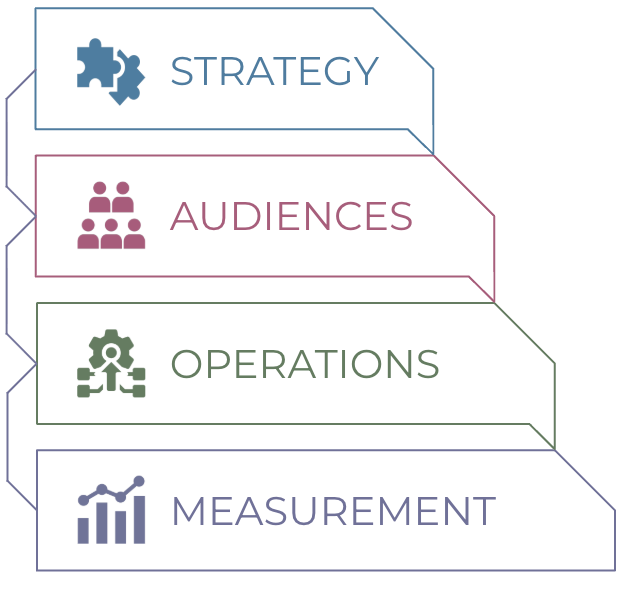
The Experience Ecosystem Framework™ (XEF) is a whole-organisation framework for managing experience across every audience, designed, delivered, and measured to a single defined standard.
This betabook makes the case for why experience must be approached differently, sets out how XEF does it, and shows what the organisations that get it right have built. The chapters that follow walk through the framework in full, illustrate it with real-world examples, and give you what you need to begin building it in your own organisation, your own client engagement, or your own thinking about how experience should be managed.


