

How does experience work?

The word "experience" carries an unusually wide range of meanings in the business lexicon. In everyday conversation it describes everything from a hotel stay to a hospital visit, a job interview to a product review, a first day at work to a last interaction with a specific brand. It is one of the most used and least precisely defined words in organisational life.
Ask ten senior leaders what experience means in the context of their business and you will usually get ten different answers, shaped by the function they lead, the audience they are closest to, and the framework through which they have been trained to think about it. For the Chief Marketing Officer (CMO) it is the emotional journey a customer takes from first awareness to loyal advocacy. For the Chief People Officer (CPO) it is the sum of how employees feel about their work, their team, and their organisation. For the Chief Operating Officer (COO) it is the efficiency and consistency of every process that impacts a customer or colleague.
All of them are right. None of them are complete. The fact that one word means something different to each of the people responsible for the delivery is one of the primary structural reasons why organisations can invest heavily in improving experience, but still find the gap between aspiration and reality stubbornly wide.
For the purposes of this betabook, experience is defined broadly, because the forces that shape it are broader than most organisations account for. The internal and the external. The commercial and the cultural. The immediate and the long-term.
Experience is the cumulative impression formed in the mind of each audience as a result of every interaction, decision, association, and outcome connected to an organisation, across every channel, touchpoint, and moment, whether designed or undesigned.
The definition describes two parties doing two different things. The organisation produces: it makes decisions, produces outcomes, builds associations, and behaves in ways its audiences observe. The audience interprets: it takes what the organisation produced and forms an impression of it, through a process the organisation neither performs nor controls.
What the organisation puts out and what the audience takes in are related but never identical. Understanding how experience works therefore means understanding both parts: what the organisation actually governs, and how audiences construct meaning from it.
How an audience forms its impression
Experience is constructed in the mind of the person having it. What an organisation produces reaches an audience, and the audience then interprets it, forming an impression shaped by what they expected, what they remember, and what they bring with them culturally. The impression belongs to them, and it will not always resemble what was intended.
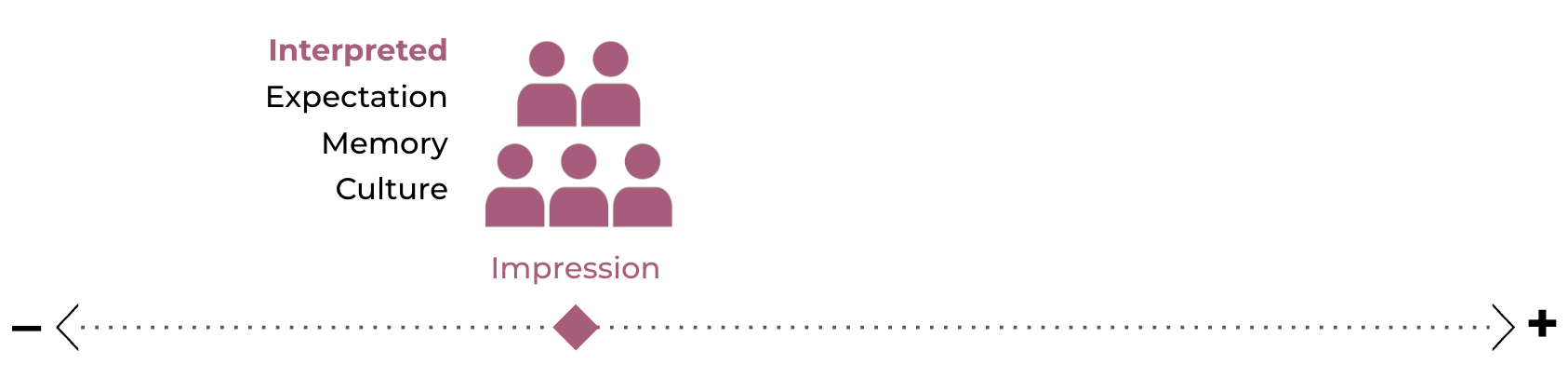
This means two people can have an identical interaction with an organisation and form completely different impressions of it. One person may walk away delighted. The other may walk away unmoved, or actively dissatisfied. The interaction itself does not change. What changes is the mind doing the interpreting. Consider two people who book the same flight, sit in the same cabin, and receive the same service. One boards having read a news story about the airline's environmental record and arrives thinking less of the organisation than when they left. The other boards having just recommended the airline to a friend and arrives feeling validated by the quality of the experience. The touchpoint was identical, the experience was entirely different.
That process of interpretation is not arbitrary, and understanding it is the precondition for managing experience strategically. Three findings, drawn from established research in psychology, behavioural economics, and cross-cultural studies, carry most of the structural consequences. They correspond to the three inputs above: what an audience expects, what it remembers, and what its culture leads it to assume. An organisation that does not understand these mechanisms will invest in touchpoints and interactions, and find that the impressions they produce do not match the intent behind them.
The expectation-reality gap
Why definition matters
In the late 1970s, the marketing scholar Richard Oliver developed what is now known as the expectation-disconfirmation theory, the foundation underlying much of the research on customer satisfaction and service quality. The proposition was straightforward: satisfaction is shaped by the gap between what was expected and what was experienced, as well as the quality of what was delivered.
A budget hotel that delivers a clean room, a warm welcome, and a faster check-in than the guest anticipated can produce a more satisfied guest than a luxury hotel that delivers an objectively better experience but falls short of the higher standard the guest came in expecting. The budget hotel exceeded expectations. The luxury hotel disappointed them. The objective quality of the experience matters, but the relationship between expectation and reality can matter just as much.
The implications for organisations are significant. Most experience improvement programmes focus on raising the absolute quality of what is delivered. They invest in better interfaces, better service standards, better physical environments, better digital tools. These investments are rarely wasted, but they frequently fail to produce the satisfaction improvements they were designed to create. Expectations do not hold still while delivery improves. Boulding and colleagues showed that people form their view of quality from what they expected going in and from their most recent contact with the organisation, updating one against the other each time. Today's improvement becomes tomorrow's baseline. Absolute quality can climb while the distance between expectation and delivery stays where it was, which is why the strongest approach works on both sides of that distance rather than one.
Sometimes the most powerful experience improvement is honest expectation-setting rather than delivery enhancement. An organisation that tells its audiences clearly what they will and will not receive, and then meets that commitment consistently, produces a more satisfied audience than one that promises more than it delivers.
Managing expectations is a fundamental part of delivering well. This is why the Audiences dimension of XEF, developed in Chapter 5, places such emphasis on defining the intended experience for each audience precisely. The definition clarifies, internally and externally, what the organisation is committing to deliver. Without that clarity, expectations form on their own, shaped by marketing claims, competitor performance, and the audience's own imagination. None of these produce expectations the organisation can reliably meet.
The peak-end rule
Why concentration matters
The second finding is drawn from the work of the psychologist and Nobel laureate Daniel Kahneman, whose research with collaborators including Don Redelmeier and Barbara Fredrickson established a fundamental insight about how the human mind processes experience over time.
Kahneman distinguished between two selves that exist within every person. The experiencing self is the part of us that lives through events as they happen, feeling pleasure or pain in real time. The remembering self is the part of us that recalls events afterwards, constructing the story of what happened and how it felt. The two selves do not always agree.
The remembering self is the one that decides whether to return, recommend, complain, or stay loyal. And it does not weigh every moment equally. Specifically, the remembering self constructs the impression of an experience based primarily on two moments: the peak (the most intense point of the experience, whether positive or negative) and the end (how the experience concluded). The length of the experience barely registers, and no single moment in between comes close to the weight of those two. This is the peak-end rule, and it has been demonstrated across contexts from medical procedures to service interactions.
The evidence for the peak-end rule is strongest in discrete episodes, meaning experiences with a clear beginning and end that a person recalls as a single event. XEF applies the principle to relationships that run for years, which extends it beyond the settings where it was established. That extension is made deliberately. Long relationships are themselves made up of episodes, and each one has its own peak and its own ending.
The implications for organisations are direct. Consistent quality across every touchpoint is worth having. What the audience carries away is shaped by something else: the moments that stood out: a moment of unexpected delight, a moment of meaningful recognition, a moment when the organisation did something they did not expect, and an ending that closed well.
In 2010, Matthew Dixon, Karen Freeman and Nicholas Toman published research covering more than 75,000 people who had dealt with contact centres or used self-service channels. They found that delighting customers did not build loyalty, and that reducing the effort customers had to make to get a problem solved did.
Read closely, the two findings work together. The effort research examined service interactions, where someone is trying to get a problem solved. Dixon and colleagues found that what people want in those moments is a simple, quick solution, and that the Customer Effort Score predicts loyalty better than satisfaction measures or the Net Promoter Score. XEF reads that as evidence of where the peak sits in a service context. The most intense moment is usually the difficulty the customer is being asked to absorb, so removing it concentrates effort exactly where the peak-end rule shows it carries most weight.
The peak-end rule may also help explain why a well-handled recovery can matter so much. An interaction that begins poorly but ends with a generous, well-handled resolution can produce a stronger remembered experience than an interaction that was uniformly mediocre with no recovery point. The end is doing the work that the rest of the experience could not.
This is why XEF returns repeatedly to the language of moments that matter most. Every audience experience definition in Chapter 5 is structured around identifying these moments and concentrating intent and investment on them. Every operating model decision in Chapter 6 is evaluated against whether it strengthens or weakens the moments that disproportionately shape audience impressions. The framework asks organisations to invest more deliberately, concentrating effort in the places where it compounds rather than dissipates.
Cultural variation in expectations
Why translation matters
The third finding moves the lens from the individual to the cultural. The Dutch social psychologist Geert Hofstede, drawing on IBM survey data, established that values vary systematically across cultures along a small number of dimensions. His specific dimensions have been contested, extended by the GLOBE project, and challenged by alternative models such as Trompenaars. The central insight, however, has held for over four decades and is supported well beyond Hofstede's own work. Donthu and Yoo took it directly to service, and found that a person's cultural orientation shapes both how much they expect and what they expect most. Cultural context shapes what audiences expect from the organisations they interact with, in ways that go far beyond surface preferences.
Cultures vary, for example, in their orientation to power and hierarchy. In some cultures, an audience expects to be treated formally, with deference to seniority and clear status signals. In others, the same formality reads as cold or distant. Cultures vary in their orientation to individualism and collectivism. In some cultures, an experience is judged by what it does for the individual. In others, it is judged by what it does for the group. Cultures also vary in their tolerance for uncertainty, and orientation to time. Each variation carries consequences for what good experience looks like in a specific cultural context.
The most consequential implication is that experience principles can be universal in their nature, but must be culturally adapted in their expression. A principle of "respect" applies in every culture, but what respect looks like varies. A principle of "responsiveness" applies in every culture, but what responsiveness feels like varies. A principle of "honesty" applies in every culture, but the conventions around how honesty is expressed without giving offence vary significantly. An organisation that tries to deliver an identical experience in every market it operates in, without adaptation, will succeed in some and fail in others, regardless of how good the experience is in absolute terms.
This is why XEF is positioned as a universal framework with deliberately context-specific application. The principles, audience experience definitions, operating model design, and measurement architecture are each developed in the cultural context of the specific organisation deploying them. The framework provides the structure. The organisation provides the cultural translation.
How an organisation delivers
Against an audience's interpretation sits what the organisation actually produces. Most organisations think of this as touchpoints: the points of contact they provide, and the interactions that happen at each one. Touchpoints matter enormously, and designing them well is important. But an audience's impression forms from everything it encounters, observes, and feels about an organisation over time, not only from what has been deliberately designed.
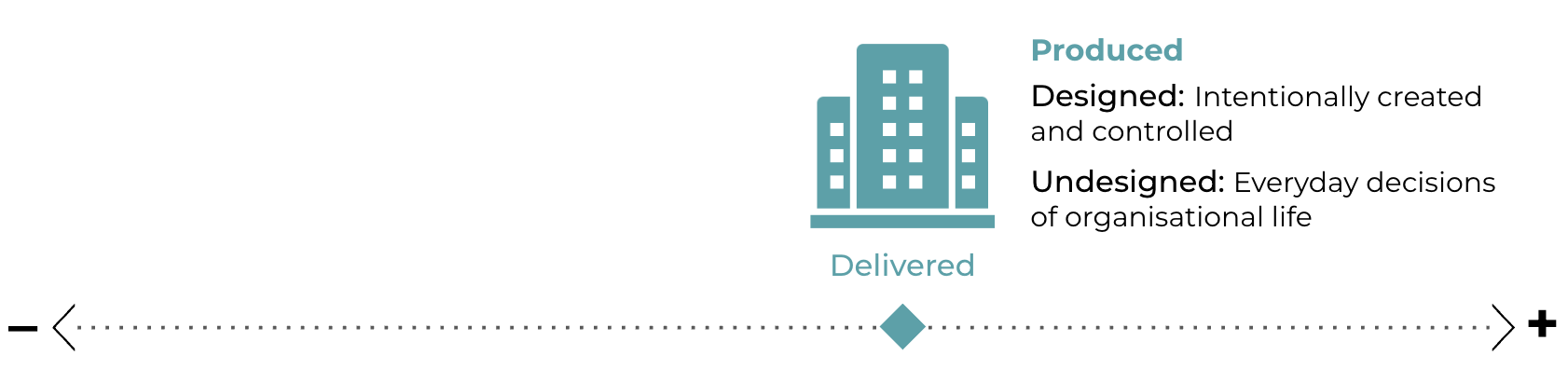
Designed experiences are the part an organisation deliberately plans and creates. Undesigned experiences are everything else, produced by the ordinary decisions of organisational life. How a pricing change is communicated. What a supplier is told when an invoice is disputed. How a manager handles a resignation. Each of these is a decision someone made intentionally. None of them were treated as experience decisions.
The person setting a payment term is making a finance decision. The person drafting a returns policy is making an operations decision. The person choosing the wording of a job rejection is making a recruitment decision. Each is made competently, against the criteria that function is accountable for, by someone with no particular reason to think of it as shaping what an audience will believe about the organisation. Because they are not seen as experience decisions, they are not reviewed as experience decisions, not measured as experience decisions, and not checked against any standard for what the organisation intends its audiences to encounter.
The undesigned portion is often the larger of the two. In most organisations it is also the part nobody governs. Responsibility for it is distributed across every function, and experience is rarely among the criteria those functions are measured on. Which is also what makes the problem addressable. These decisions are simply being made without a standard, and a standard is something an organisation can supply.
This changes where the work sits. If experience is a touchpoint problem, it belongs in functions that control them. If experience is an impression problem, shaped by culture, values, operations, leadership behaviour, public associations, and a thousand small decisions made every day by people across the organisation, then it belongs everywhere.
Where the two meet
Put how the audience forms its impression and how the organisation delivers together and the difficulty becomes visible. An organisation produces more than it designs, and governs less than it produces. Audiences form their impression from all of it, designed and undesigned alike, and they do so through mechanisms of expectation, memory, and cultural interpretation that the organisation neither performs nor controls.
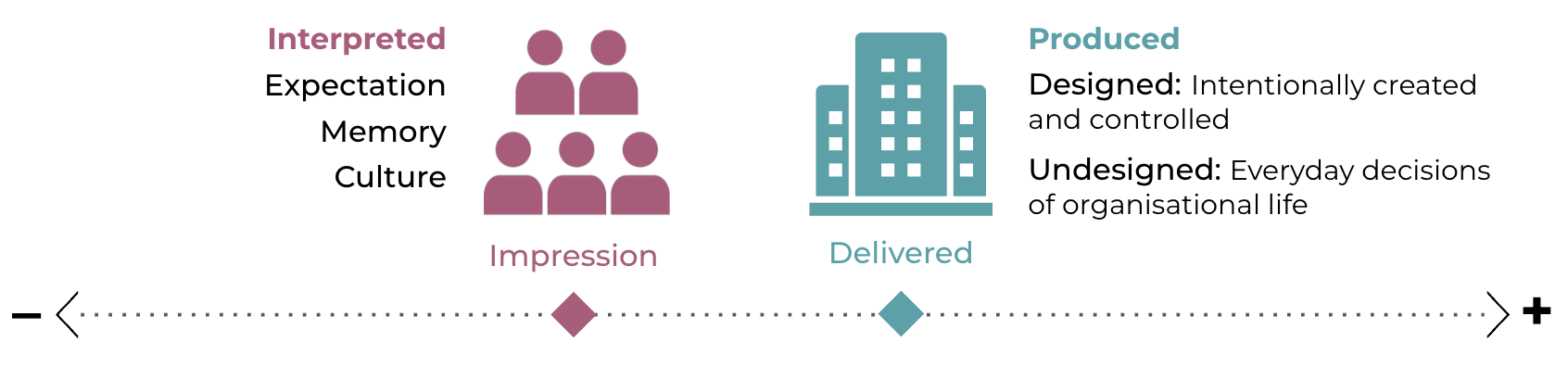
That creates two independent sources of divergence. The organisation is not governing everything it puts out. And the audience is not receiving what the organisation believes it sent. Either one alone would be enough to separate delivery from impression. Together they compound.
Experience is the product of two things working together: what an organisation produces, and how the audiences receiving it construct meaning from what was done. Both are judged against a third component: what the organisation promises to deliver in the first place. That commitment is the fixed point from which everything else is measured, and it has a dual role. It is the standard delivery is held to, and it is one of the strongest influences on what audiences expect. An organisation that promises more than it can deliver pays for it twice. The promise sets the standard its delivery will be judged against, and it raises what audiences expect before they encounter anything at all.
That distance is the experience gap. Why it has continued to widen, despite decades of research and significant investment, is the question the next section explores.


